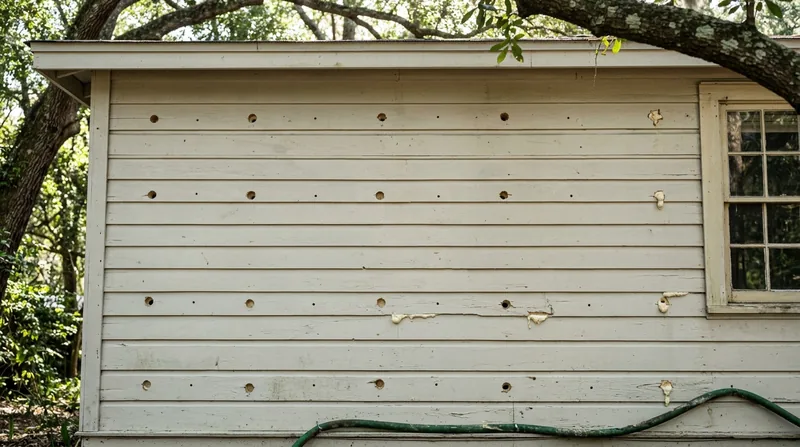




Wall & Injection Foam Insulation in Tallahassee addresses a specific problem that runs through Midtown's older frame homes and extends across Killearn and Southwood: empty wall cavities that leak conditioned air into the humid Florida climate. Homes built before modern building science, especially those along the canopy roads where live oaks shade the streets, often have walls framed with no insulation or with insulation that has settled or failed over decades. Moisture-laden air enters from outside through these gaps, raising cooling loads through a long season that runs nine months a year. Injecting foam into finished walls lets you seal those cavities without demolition, without tearing out drywall, and without the mess and cost of a full wall rebuild. We work in Tallahassee, Bradfordville, Crawfordville, and surrounding Leon County communities to restore thermal control to homes that never had it or have lost it.
Why Wall & Injection Foam Insulation Matters in Tallahassee's Older Housing Stock
Tallahassee's building landscape is split between older frame homes in established neighborhoods and newer construction in master-planned areas. The older stock, particularly Midtown and areas near downtown, was built to different standards: thin walls, no cavity insulation, and vented attics that pull in the humidity that defines our climate. A typical Midtown home from the 1950s or 1960s has walls that are completely empty or filled with degraded fiberglass that has compressed to half its original R-value. In our hot, humid climate, conditioned air leaks out through those cavities, and humid outside air leaks in. The result is constant air conditioning cycling and higher cooling bills through a season that runs from April through October and often into November.
- Empty wall cavities in pre-1980 homes allow conditioned air to escape without passing through any insulation layer.
- Humid outside air enters through wall leaks and moves into attics and crawl spaces, keeping ductwork damp and reducing HVAC efficiency.
- Injection foam seals cavities from the inside without removing drywall, plaster, or exterior siding.
- Closed-cell foam in walls provides both insulation and air sealing, stopping convective air movement that fiberglass cannot block.
- A finished wall retrofit costs far less than demolition and replacement, and the home remains fully occupied during the work.
Stopping air leakage in walls is one of the highest-return improvements a Tallahassee homeowner can make, because the failure mode here is not insulation value alone but air movement driven by humidity and temperature difference.
Key info: A Midtown home with empty cavities in exterior walls may lose as much conditioned air through those walls as through an uninsulated attic. Injecting foam into those cavities, combined with air sealing around rim joists and band joists, often cuts cooling costs more than any other single retrofit.
How We Inject Foam Into Finished Walls in Tallahassee
Injection foam insulation works by drilling small access holes into the finished wall cavity, then pumping low-pressure foam into the space until it expands to fill every corner. The holes are then patched and painted to match the existing wall. The whole process is non-invasive, leaves no debris, and takes one to three days depending on wall area and cavity layout. We start with a site inspection to map the wall cavities, understand the wall construction (stud spacing, blocking, existing wiring or plumbing), and plan hole placement to reach every void without hitting mechanical systems.
- We drill small access holes, typically one per stud bay, at a height chosen to avoid wiring and plumbing runs.
- Foam is injected at low pressure to fill the cavity without forcing drywall outward or creating voids.
- We monitor cavity pressure and foam expansion in real time to ensure complete fill and proper density.
- Holes are patched with foam-compatible sealant and sanded flush before primer and paint.
- We verify R-value and thickness on the estimate and document the work with photos and written specifications.
The result is a sealed wall cavity that stops air leakage, adds thermal resistance, and reduces the moisture pathways that drive cooling load in Tallahassee's climate.
Example: A 1960s home in Killearn with 800 square feet of exterior wall cavity typically takes two days to inject and patch. The homeowner stays in the house, and the work is complete before the patch primer dries.
Injection Foam Methods and When to Use Each
| Method | Description | Best For |
|---|---|---|
| Closed-Cell Injection | High-density foam injected into cavities at low pressure, expands to fill voids and cure hard within 24 hours. Provides air sealing and moisture resistance. | Finished walls in older homes, rim joists, band joists, any cavity where air leakage and humidity control matter most. |
| Open-Cell Injection | Lower-density foam that expands to fill cavities and allows vapor transmission. Cures to a softer state and can be cut or trimmed after cure. | Interior walls where vapor permeability is desired, sound dampening is a secondary benefit, and cost must stay below closed-cell. |
| Partial-Fill Injection | Foam injected to a specified thickness rather than a full cavity fill, used when existing fiberglass or mineral wool is present and top-up is the goal. | Walls with degraded insulation where complete removal is impractical and adding R-value over existing material is acceptable. |
| Cavity Inspection and Selective Fill | Small camera probe inserted to map cavity condition, blockages, and wiring before foam injection begins. Holes placed to avoid obstacles and ensure complete fill. | Complex older homes with unknown wall construction, multiple utility runs, or blocked cavities that require precision planning. |
Closed-cell foam is the standard for wall injection in Tallahassee because it stops air leakage and resists moisture ingress, both critical in our humid climate. Open-cell is chosen when cost is the limiting factor or when vapor permeability is specifically desired. We recommend closed-cell for exterior walls and rim joists, and we discuss the trade-off plainly on every estimate.
Wall & Injection Foam Insulation Cost in Tallahassee: What to Expect
Wall injection foam in Tallahassee typically starts at $2 per square foot of wall cavity and ranges upward based on several concrete factors. The size of the wall area is the primary driver, but cavity depth, existing obstructions, hole accessibility, and foam type (closed-cell versus open-cell) all affect the final number. A small retrofit of 200 to 300 square feet might run $400 to $600, while a full-home exterior wall retrofit of 1,200 to 1,500 square feet can reach $2,400 to $3,000 or more. Patching, primer, and paint are included in most estimates. Getting a free written estimate is the only way to know your actual cost, because every older home in Tallahassee is built differently.
Factors that move the price up include walls with multiple utility runs (electrical, plumbing, HVAC ducts), cavities partially filled with existing insulation that must be worked around, and exterior walls on corners or complex shapes that require more access holes. Homes in Bradfordville, Crawfordville, and Woodville often have deeper wall cavities and simpler layouts than Midtown homes, which can lower cost per square foot. We provide estimates with R-value and thickness specifications so you can compare our work to other bids on an apples-to-apples basis.
For detailed pricing and examples, visit our full pricing overview. If you are considering wall injection as part of a larger retrofit that includes attic spray foam insulation or crawl space foam, bundle pricing is often available.
What to Look for When Hiring a Wall & Injection Foam Contractor Near Me in Tallahassee
Wall injection is a technical job, and the difference between a careful installation and a rushed one shows up in comfort and energy bills for years afterward. A reputable contractor will provide a written estimate that names the foam type, the R-value per inch, the expected thickness, and the total board feet or square footage being filled. The estimate should also explain what happens if the cavity is blocked or if existing insulation is encountered. Ask for references from recent jobs in your neighborhood, and call at least two to ask about the quality of the patch work and whether the home felt warmer and drier after the work. Verify that the contractor is fully insured and ask for a certificate of insurance before work begins.
Permits for wall injection are rarely required in Tallahassee or surrounding Leon County, but always check with your city or county building department before you book. If your home is in an HOA-governed community like Killearn or Southwood, check your architectural guidelines to confirm that interior wall work does not require approval. When you get your estimate, ask the contractor how they will protect your home during the work, what mechanical ventilation will be running during and after foam cure, and when you can safely re-enter the work area. A re-entry window of 24 to 48 hours is standard for closed-cell foam in wall cavities. Call us at (850) 273-4971 or request a free estimate online to discuss your specific wall layout and get a firm price with no obligation.
Wall & Injection Foam Insulation in Tallahassee: Pricing Guide
| Service | Price | Details |
|---|---|---|
| Wall Cavity Injection (Closed-Cell) | Starting at $2/sq ft | Exterior and interior walls, stud cavities filled with closed-cell foam for air sealing and moisture resistance in Tallahassee's humid climate |
| Partial-Fill or Top-Up | Starting at $1.50/sq ft | Existing degraded insulation present, closed-cell foam added to boost R-value without full cavity removal or demolition |
| Open-Cell Wall Injection | Starting at $1.25/sq ft | Interior walls where cost is primary driver and vapor permeability acceptable, lower density foam for sound dampening benefit |
| Complex Retrofit (Multiple Utilities, Blocked Cavities) | On estimate | Homes with electrical, plumbing, or HVAC runs requiring selective hole placement and cavity inspection before foam injection begins |
| Patching, Primer, Paint | Included | All access holes patched with foam-compatible sealant, sanded, primed, and painted to match existing wall finish |
| Free Estimate | No charge | Written estimate with R-value, thickness, and board-foot specification, response within 24 hours at (850) 273-4971 |
Indicative pricing, the exact cost depends on square footage, finish, and site access. Free personalized estimate within 24h at (850) 273-4971.


