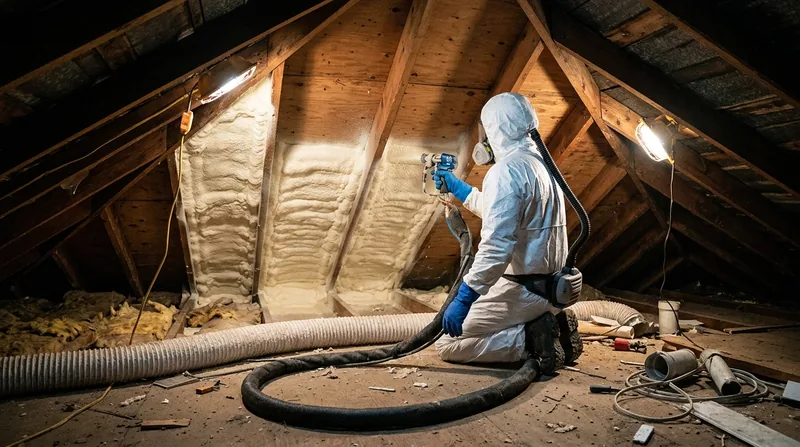




Tallahassee's older homes along the canopy roads in Midtown, the rental stock near Florida State and FAMU, and the newer subdivisions in Killearn and Southwood all share a common problem: insulation that fails in a hot, humid climate. Vented attics and crawl spaces pull in damp outside air for nine months of the year, keeping ductwork and insulation wet and pushing cooling bills higher every month. Insulation replacement and re-insulation in Tallahassee is not a cosmetic upgrade. It is the difference between a home that holds its temperature and one that bleeds air and moisture into the walls. After removal of failed fiberglass, wet cellulose, or settling mineral wool, spray foam insulation seals the thermal envelope and stops the cycle. We install open and closed cell foam in attics, crawl spaces, and walls across Leon, Gadsden, Jefferson, Wakulla, Liberty and Madison counties. Our approach is straightforward: assess what is there, remove what does not work, seal what leaks, and install insulation matched to the climate and the use case. Learn more about our full range of spray foam services.
Why Insulation Replacement Matters in Tallahassee's Hot, Humid Climate
Tallahassee sits in IECC climate zone 2A, hot and humid, where moisture drives inward through walls and attics nearly year-round. Vented attics and crawl spaces are designed to breathe, but in this climate they breathe in damp air that never fully dries. Fiberglass insulation absorbs moisture and loses R-value. Cellulose settles and compacts, leaving gaps at the eaves where the attic loses conditioned air. Old mineral wool becomes a path for moisture and heat transfer, not a barrier to it. The result is steady cooling load, mold risk in the crawl space, and ductwork that runs inefficiently because the space around it is not sealed.
- Vented attics pull in humid outside air that keeps insulation damp and reduces its effectiveness year-round.
- Settling fiberglass and cellulose leave gaps and thermal bridges where air leaks into the conditioned space.
- Old insulation often contains asbestos or other hazardous materials that require professional removal, not DIY cleanup.
- Spray foam seals the thermal envelope and stops moisture from migrating into walls and attics from the outside.
- Sealed attics and crawl spaces eliminate the source of the problem and lower cooling bills over the long season.
The failure is not the age of the insulation alone. It is the climate and the venting strategy that made sense in a dry climate but fails in Tallahassee.
Key info: Tallahassee's humidity stays above 60 percent most of the year. A vented attic or crawl space in Killearn or Southwood will pull in that outside air, and the insulation inside will stay damp. Sealed attics and closed cell foam in crawl spaces stop the moisture at the rim and band joist, not inside the cavity.
For guidance on what applies at your address, contact the City of Tallahassee Building Department or your county building official. Attic ventilation, ignition barriers, and thermal barriers are governed by the energy and building code in force where you live. Learn how we remove old insulation safely before installation.
How We Handle Insulation Replacement and Re-Insulation in Tallahassee
The process begins with a walk-through of the attic, crawl space, or walls. We assess the existing insulation, identify air leaks, check for moisture or contamination, and determine whether the substrate is sound enough to spray. If the old insulation is wet, moldy, or sitting on a leaking roof or failing crawl space, we fix the moisture first or we walk away. Removal comes next. We haul out the failed insulation and dispose of it responsibly. Then we seal the thermal envelope, air-seal around rim joists and band joists, and install new foam to the thickness and density that matches the climate and the building code at your address.
- We inspect the attic or crawl space and identify failed insulation, air leaks, and any moisture or contamination.
- We remove old insulation, fiberglass, cellulose, or mineral wool, and haul it away.
- We air-seal around penetrations, rim joists, and band joists before foam installation begins.
- We spray open or closed cell foam to the thickness and R-value specified by code and site conditions.
- We provide written estimates with R-value and thickness specs before any work starts.
- We ensure mechanical ventilation during cure and observe a re-entry window of twenty-four to forty-eight hours.
The entire process is documented and transparent. You get a clear picture of what was there, what we removed, and what we installed.
Example: A 1970s ranch home in Midtown Tallahassee has a vented attic with R-11 fiberglass that has settled to R-5 and absorbed moisture. The crawl space is damp. We remove the fiberglass, seal the rim joist with closed cell foam, install open cell foam in the attic to R-38, and air-seal around the attic hatch and ductwork penetrations. The result is a sealed attic, a dry crawl space, and lower cooling bills through the summer.
See how we handle crawl space insulation and moisture control.
Methods and Materials for Insulation Replacement
| Approach | Description | Best for |
|---|---|---|
| Open Cell Foam Attic Retrofit | Low-density foam sprayed to R-30 to R-38, air-permeable, cost-effective. | Attics where vapor permeability is acceptable and cost is a factor. Sound dampening in rooms over garages. |
| Closed Cell Foam Crawl Space and Rim Joist | High-density foam, vapor-impermeable, moisture barrier, higher R-value per inch. | Crawl spaces, rim joists, band joists, and metal buildings where condensation control and moisture are concerns. |
| Injection Foam Wall Retrofit | Low-pressure foam injected into existing wall cavities without demolition. | Pre-1980 homes in Killearn and Midtown with hollow walls and no existing insulation. |
| Sealed Attic Conversion | Foam sprayed to the underside of the roof deck, eliminating the vented attic entirely. | Homes where ductwork is in the attic or where the vented attic is a source of moisture and air leakage. |
The choice between open and closed cell depends on the climate, the space, and the failure mode. In Tallahassee, crawl spaces and rim joists almost always need closed cell because moisture control is the dominant issue. Attics can use open cell if the roof is sound and ventilation is not required by code. Learn more about closed cell foam and its R-value.
Insulation Replacement and Re-Insulation Cost in Tallahassee: What to Expect
Insulation replacement is priced by the board foot on site, after we measure the space and assess the removal scope. A typical attic re-insulation in a Tallahassee home runs from $2,800 to $6,500, depending on attic size, existing insulation load, and the choice between open and closed cell. A crawl space with rim joist sealing can range from $3,500 to $8,000. Wall injection foam in a pre-1980 home typically starts at $2,000 to $4,000 per zone. The cost is driven by three factors: the square footage to be insulated, the R-value and thickness specified by code, and the removal scope. If the existing insulation is wet, contaminated, or hazardous, removal takes longer and costs more. If the substrate is sound and dry, we can move faster.
The best way to understand cost is to get written estimates with R-value and thickness specs from two or three contractors. Do not rely on price alone. Verify that the estimate includes removal, air sealing, and the exact thickness and density of the foam to be installed. A vague estimate with no R-value spec and no thickness is a red flag. See our full pricing overview and request a free estimate.
Spray foam installation is not a commodity. The difference between a $2,800 job and a $2,000 job is often the removal scope, the air sealing detail, and the installer's experience with this climate. We charge what the work is worth, and we stand behind it.
Insulation Replacement and Re-Insulation Near Me: What Tallahassee Homeowners Should Know When Hiring a Contractor
Hiring a spray foam contractor is not like hiring a general contractor. The work is specialized, the materials are hazardous during application, and the quality of the installation directly affects your home's energy performance and indoor air quality. Start by asking whether the contractor is fully insured and can provide a certificate of insurance. Ask for references from recent jobs in Tallahassee, Killearn, Southwood, or nearby areas. Call those references and ask whether the installer showed up on time, cleaned up after himself, and was reachable if questions came up after the job. Request a written estimate that includes the R-value, the thickness in inches, and the square footage of the area to be sprayed. If the estimate is vague or the price is far below market with no detail, walk away.
Ask the contractor how he handles permits and what code applies at your address. Attic ventilation, ignition barriers, and thermal barriers are governed by the energy and building code in force at your location, not by the contractor. The contractor should be able to tell you what the local building department requires and help you navigate it. If you have an HOA, ask whether exterior work on metal buildings or rim joists requires architectural approval. If you are unsure, contact your HOA directly.
During the installation, the contractor should use mechanical ventilation and post a re-entry window of twenty-four to forty-eight hours. If he promises immediate re-entry or says the smell will be gone in a few hours, that is not how spray foam cures. The smell and the off-gassing are normal, and they require ventilation and time. A professional will explain this upfront and manage your expectations.
Contact us for a free, no-obligation estimate and a walk-through of your attic or crawl space.
Insulation Replacement & Re-Insulation in Tallahassee: Pricing Guide
| Service | Price | Details |
|---|---|---|
| Attic Re-Insulation (Open Cell) | Starting at $2,800 | Removal of old insulation, air sealing, and open cell foam to R-30 to R-38 in a 1,000 to 1,200 square foot attic |
| Crawl Space and Rim Joist Sealing (Closed Cell) | Starting at $3,500 | Removal of old insulation, closed cell foam on rim joists and band joists, moisture barrier installation in a 1,000 to 1,200 square foot crawl space |
| Wall Injection Foam Retrofit | Starting at $2,000 | Low-pressure injection foam into hollow wall cavities without demolition, per zone or per exterior wall in pre-1980 homes |
| Sealed Attic Conversion | On estimate | Roof deck spray, removal of vented attic insulation, and ductwork sealing require site assessment and sizing before pricing |
| Travel and Mobilization | Included | No separate mileage or travel fee within Tallahassee, Bradfordville, Crawfordville, and surrounding Leon County service areas |
| Free Estimate | No charge | Written estimate with R-value and thickness specs, response within 24 hours at (850) 273-4971, no obligation to book |
Indicative pricing, the exact cost depends on square footage, finish, and site access. Free personalized estimate within 24h at (850) 273-4971.


